
Who is Really Holding the Phone?
Who Is Really Holding the Phone?
And the four costs worth naming before we go any further
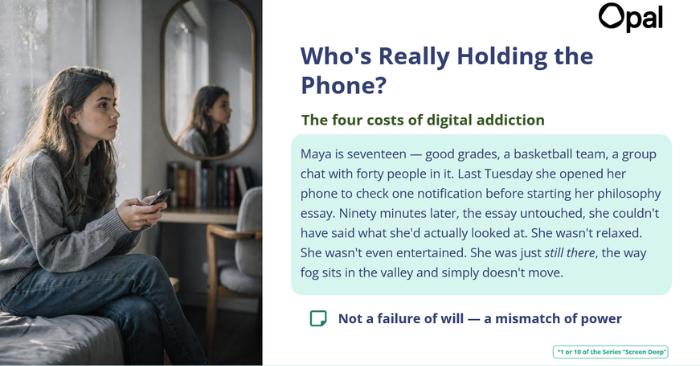
Maya is seventeen and, by every measure that used to matter, doing fine. Good grades, a place on the lycée's basketball team, a group chat with forty people in it. Last Tuesday evening, in a house not unlike the ones scattered along the mountain roads along the Belledonne, she opened her phone to check one notification before starting her philosophy essay — due, as these things always seem to be, the next morning. Ninety minutes later, the essay untouched, she couldn't have said what she'd actually looked at: a video, a reply, another video, a different app entirely, back to the first one. She wasn't relaxed. She wasn't even entertained, really. She was just still there, the way fog sits in the valley some mornings and simply doesn't move. When her mother called up the stairs to ask how the essay was coming along, Maya felt a jolt of something closer to panic than guilt. She hadn't decided to spend ninety minutes on her phone. It had simply happened to her.
Ask Maya if she's “addicted” to her phone and she'll laugh it off — addiction, in her mind, is something that happens to other people's children, not to a good student with a basketball match on Saturday. But I've spent enough years now watching how systems — human and algorithmic — capture attention for a living, first in enterprise data, now in the governance of agentic technologies, to know that the word deserves more precision than either dismissal or panic. What happened to Maya on Tuesday night has a name, a mechanism, and, increasingly, a body of research behind it.
The shift: it's not about willpower
The instinct, for most parents and no shortage of students, is to frame this as a discipline problem: use less self-control, leave the phone in the entryway, try harder. I understand the appeal of that framing — it's the same one my own generation applied to television, and my grandparents' to novels, for that matter. But it misses what's actually happening. Digital addiction isn't primarily a failure of will — it's the predictable output of systems engineered, deliberately and with considerable sophistication, to override it. Infinite scroll, variable rewards, autoplay, feeds that learn a teenager's weak points faster than the teenager does: these are not neutral design choices. They are the same reinforcement architecture that makes a slot machine compelling, applied to a device most adolescents carry through eight or more waking hours a day.
I think about this the way I might think through an opening in chess: the position looks like a fair fight, two players of equal standing, but one side has been studying the other's habitual responses for years before the first move is even made. That is closer to what a seventeen-year-old is up against than any lecture about self-control.
That reframe matters for everything the rest of this series will explore. If the problem were simply “not enough discipline,” the fix would be a scolding. Since the problem is a mismatch — an adolescent brain whose impulse control and reward regulation don't finish developing until the mid-twenties, set against an attention economy built explicitly to exploit that gap — the fix has to be something else entirely: understanding the mechanism clearly enough to work with it, rather than shaming students for losing a match that was never played on equal terms.
What the research shows
Start with a definition. Digital addiction — sometimes termed problematic or compulsive digital use — describes a pattern of preoccupation, loss of control, escalation, and continued use despite clear costs. It is the same clinical signature found in other behavioral addictions, applied here to smartphones, social media, gaming, or the internet more broadly. This is far from a fringe phenomenon among adolescents. A 2025 narrative review in the American Journal of Health Research put an estimated 73% of 13-to-17-year-olds in an at-risk category for problematic digital use. That rate declines steadily through adulthood, though never to zero. The same review found something else worth pausing on: more than half of those seeking help for internet addiction also report co-occurring anxiety or depression. The compulsive use and the mental strain appear to travel together, rather than one simply causing the other.
Jonathan Haidt's 2024 The Anxious Generation popularized a related, more contested claim: that the mass adoption of smartphones between roughly 2010 and 2015 “rewired” adolescent development, in step with rising anxiety and depression across many countries at once. I try to hold my own students in the Business Analytics Institute to a certain standard when they reach for a tidy causal story, and fairness requires the same standard here. Haidt's critics, including a review in the LSE Review of Books, have pushed back on how much can be attributed to phones specifically. Other things shifted in the same window — the decades-long decline in unsupervised outdoor play, for one. I notice that decline even here, in a commune where children once ran the trails above the village largely unaccompanied; that freedom has narrowed everywhere, not only in cities. The honest summary: smartphones are very likely part of the story, not proven to be the whole of it. That nuance is more useful to a student than a clean villain would be.
What researchers agree on more confidently is the mechanism itself, independent of the broader causal debate: persuasive design exploits heightened reward sensitivity and still-maturing cognitive control in adolescents specifically — which is why the same application can be background noise to a person my age and genuinely difficult to put down for a seventeen-year-old.
What this looks like in practice
Digital addiction rarely announces itself as dramatically as the word suggests. At home, families tend to notice it first as a scheduling problem: homework that reliably takes twice as long as it should, “I'll just check one thing” that never stays at one thing, a phone reached for during any pause longer than a few seconds — waiting for the bus down to Grenoble, a lull at the market on a Saturday morning, a silence at the dinner table. Most tellingly, families often notice it as a mood problem before anything else — irritability specifically when access is interrupted, disproportionate to whatever was actually interrupted.
At school, it shows up differently, as an attention problem: students who read a paragraph and cannot say what it contained, not for lack of intelligence but because part of the mind is still elsewhere. A teacher who has taught the same course for a decade will tell you this is new — not that students daydream, which they always have, but that the daydream now has a specific, engineered pull to it.
None of these signs, taken alone, amounts to “addiction” in a clinical sense. They mean it is worth paying attention — which is, not coincidentally, exactly the resource this entire pattern is designed to take from you.
A path forward
This series is not going to argue for throwing the family's phones into the Lac de la Vieille Morte. A few smaller, more realistic starting points:
- Notice without judging. For one week, a student might simply track — no changes, just observation — how many times a day the phone is picked up without a decision behind it. Awareness is the precondition for everything that follows in this series.
- Name the four domains. Over the coming articles, we will examine specifically how this pattern affects learning, creativity, reasoning, and relationships — four areas where the cost is not merely “time,” but something harder to recover.
- Treat it as a design problem, not a character problem. I find families have an easier conversation once “you're too weak-willed” is off the table and “this was built to be hard to put down” is on it. It is, after all, the same reframing I ask of executives when we discuss why a well-designed dashboard captures attention that a poorly designed one never could.
- Protect one deliberately unplugged ritual. It doesn't need to be elaborate — a Sunday walk up toward the Belledonne, a market run in Uriage without a phone in hand, a meal where devices stay in another room. The point isn't the activity; it's practicing, on a schedule, what it feels like to want to check and not do it.
Questions worth sitting with
- If the applications on your phone were designed by people who study exactly how your attention works — and they were — whose responsibility is it to manage the outcome: yours, theirs, or both?
- Think of the last time you “lost” more time than you meant to online. What were you actually looking for in that moment — information, connection, distraction, or something you couldn't quite name?
- Is there a difference between a habit you would choose again deliberately, and one you have simply never gotten around to questioning?
- Maya's essay was still unwritten at midnight. If you're a student reading this on your own phone right now — what's the one thing today that a notification quietly pushed to tomorrow?